Why Ray Tracing Still Matters in 2024 What is Ray Tracing? Ray tracing is a rendering technique that simulates how light interacts with objects in a 3D environment. It creates ultra-realistic effects by tracing individual rays of light as they bounce off surfaces. Mimics real-world lighting behavior Produces detailed shadows, accurate reflections, and ambient lighting
Why Ray Tracing Still Matters in 2024
What is Ray Tracing?
Ray tracing is a rendering technique that simulates how light interacts with objects in a 3D environment. It creates ultra-realistic effects by tracing individual rays of light as they bounce off surfaces.
- Mimics real-world lighting behavior
- Produces detailed shadows, accurate reflections, and ambient lighting
- Significantly enhances realism in supported games
Visual Impact on Modern Games
Games that support ray tracing stand out with cinematic visual quality. Whether it’s lifelike water reflections, soft shadows, or the atmosphere created by global illumination, ray tracing adds unmistakable depth and immersion to the experience.
- Real-time lighting adjustments improve immersion
- Shadows have smoother gradients and proper occlusion
- Reflections realistically adapt to dynamic environments
The GPU Still Matters
Despite software optimizations, ray tracing remains resource-intensive—especially at higher resolutions like 1440p and 4K. Your choice of graphics card directly impacts frame rates, detail levels, and whether you can enable advanced features like DLSS or FSR.
- High-performance GPUs are still required
- VRAM and ray tracing cores make a major difference
- Cooling and power management also play a role in sustained performance
For a deeper dive into how this tech works and its evolution in gaming, check out this resource: Ray Tracing in Games
Top Performers in 2024
When choosing a graphics card for ray tracing in 2024, the landscape offers options for every kind of gamer. Whether you’re aiming for top-tier performance or hunting for value, here’s a breakdown of standout GPUs across different price points.
High-End GPUs: For 4K and Max Settings
If you’re chasing ultra settings with ray tracing on and want futureproof performance, these cards are the best of the best:
-
NVIDIA GeForce RTX 4090
-
Massive performance headroom
-
Excellent ray tracing and DLSS 3 support
-
Best for 4K gaming with all settings maxed out
-
Requires a powerful PSU and efficient cooling setup
-
NVIDIA GeForce RTX 4080 Super
-
Slightly more affordable than the 4090
-
Great performance-to-watt ratio
-
Ideal for gamers who want strong ray tracing at 1440p or decent 4K
Mid-Range GPUs: Balanced Power & Price
A solid choice for most gamers who want high-quality ray tracing without the premium price tag.
-
NVIDIA GeForce RTX 4070 Ti
-
Smooth performance at 1440p with ray tracing enabled
-
DLSS 3 support makes demanding games playable
-
Efficient thermals and power usage
-
AMD Radeon RX 7800 XT
-
AMD’s best mid-tier ray tracing GPU
-
Strong native rendering performance
-
Slightly behind NVIDIA in ray tracing, but gains with FSR
Entry-Level GPUs: Affordable Ray Tracing Starts Here
For budget-conscious gamers stepping into ray tracing, these are your most accessible options:
-
NVIDIA GeForce RTX 4060 Ti
-
Entry point for DLSS 3 and decent ray tracing
-
Ideal for 1080p or light 1440p gaming
-
Compact design fits smaller builds
-
AMD Radeon RX 7600
-
Budget-friendly with fair ray tracing support
-
Solid for esports and optimized AAA titles
-
Pairs well with FSR and smart upscaling
Real-World Performance & Cooling
Benchmarks show:
- RTX 4090 and 4080 Super lead in both rasterized and ray-traced workloads
- RX 7800 XT often trades blows with the RTX 4070 Ti in native performance
- Entry-level cards deliver reasonable frame rates at 1080p but may struggle at higher resolutions with ray tracing enabled
In terms of cooling:
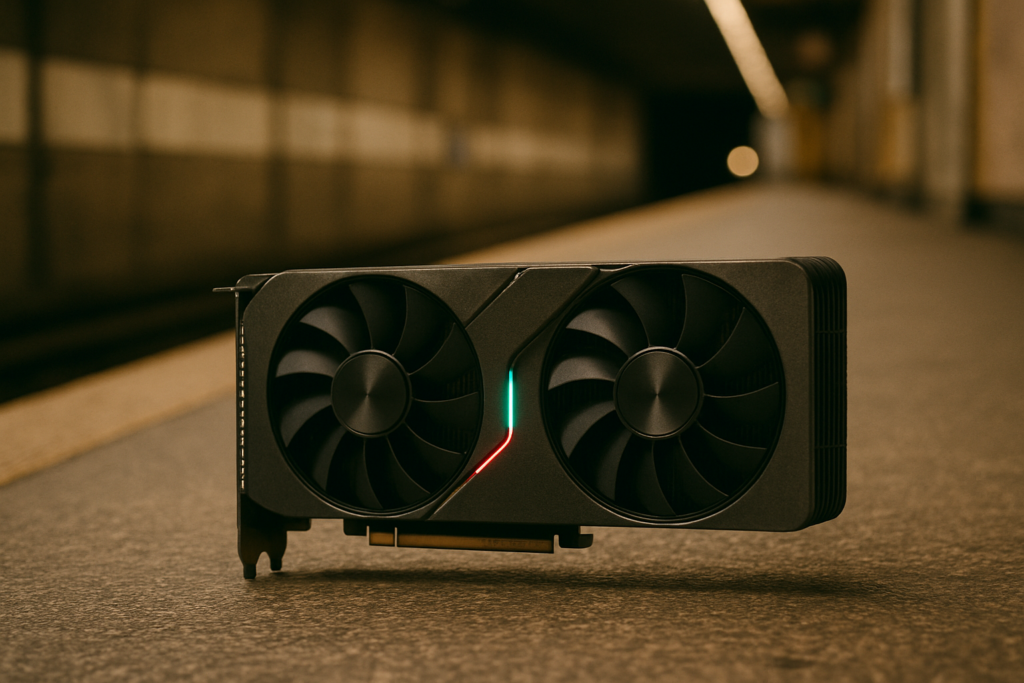
- High-end cards generally require 3-slot designs and strong airflow
- Mid-range GPUs are efficient and quieter under load
- Entry-level models run cool, but ensure your case has decent circulation
Choose for your resolution, workload, and build space—and always check wattage requirements before upgrading.
Key Factors to Consider When Choosing a GPU
Picking a graphics card in 2024 means more than chasing the highest specs. Let’s break down what actually matters:
Ray tracing cores: Not all RT cores are equal. Look at the generation and count. NVIDIA’s third-gen RT cores in the 40-series are more efficient and faster than older models. AMD’s latest RDNA 3 cards also bring solid performance, but be cautious with lower-tier cards where ray tracing can still drag frame rates.
VRAM for AAA titles: Games are asking for more VRAM, especially at 1440p and 4K. You’ll want a minimum of 12GB for modern AAA games with ray tracing on. Cards with 8GB are now best case for 1080p or lighter workloads.
DLSS and AI upscaling: DLSS 3 and Frame Generation from NVIDIA offer real performance boosts without raw power. They also help stabilize ray tracing-heavy scenes. AMD’s FSR 3 is improving, but DLSS still holds the edge for now. It’s about smart rendering, not just brute force pixel pushing.
Game engine support and drivers: Not every game or engine supports every feature. Unreal Engine 5 is pushing ray tracing forward hard, but some studios still skip it. You also want a card from a brand with fast, stable driver updates. No use buying powerful hardware if it’s poorly supported.
Budget vs. performance: Your use case matters. Are you trying to hit 60fps at 4K with ultra settings? Or just want solid 1080p with some flair? Balance matters. Don’t overspend chasing peak specs you won’t fully use. And don’t undercut yourself by going too cheap either—you’ll just upgrade sooner than you think.
Is NVIDIA Still Leading in Ray Tracing?
When it comes to raw ray tracing performance, the GeForce RTX 40-Series cards leave little room for debate. These GPUs are built with third-gen RT cores and fourth-gen Tensor cores, which work in tandem to deliver stunning lighting effects without compromising frame rates as harshly as in previous generations.
At the top, the RTX 4090 handles 4K ray tracing like a walk in the park, averaging triple-digit frame rates in titles like Cyberpunk 2077 and Alan Wake 2 with all the effects dialed up. The RTX 4080 Super isn’t far behind either, making it a strong pick for high-end 1440p or entry-level 4K gaming setups where visual fidelity actually matters.
DLSS 3 is where NVIDIA ups the ante. With optical multi-frame generation built in, it doesn’t just upscale—it creates entirely new frames between rendered ones, smoothing out gameplay while keeping loads off the GPU. It’s not magic, but it’s close. The result is a frame boost that makes demanding games feel far more playable, especially when ray tracing is turned on. And the best part? It maintains sharp visuals that hold up even during fast movement.
Bottom line: NVIDIA’s 40-Series GPUs are still the top choice for gamers who want it all—power, fidelity, and a bit of future-proofing. If you want to get more specific, check out this in-depth breakdown: NVIDIA RTX 40 Review.
Final Word
There’s no single best graphics card—it all comes down to what you want, what you play, and what kind of display you’re running. If you’re gaming at 1080p or 1440p, you don’t need to chase the top-tier cards. But if you’re after 4K with maxed-out settings and full ray tracing, you’re gonna need the muscle to back it up.
Ray tracing still separates casual visuals from true realism. If depth, details, and accurate lighting matter to you, you’ll want a card designed for it. That means dedicated RT cores, high VRAM, and ideally, access to features like DLSS or FSR.
Also—don’t get tunnel vision on just the GPU. Check your case size, airflow, and especially your power supply. Some of these cards draw serious power and run hot. Pick a card that fits your system as well as it fits your wishlist.
TL;DR Buyer Recommendation
If you’re gaming at 1440p and want smooth performance with high settings and ray tracing on, go for the RTX 4070 or the AMD RX 7800 XT. Both deliver strong frame rates and enough VRAM to handle modern titles without breaking your budget. They’re also relatively efficient, so you won’t need to overhaul your entire rig.
For gamers chasing pure visual fidelity at 4K with ultra settings and ray tracing fully enabled, nothing less than an RTX 4090 or 4080 Super will do. These are the heavy-hitters. They’re expensive, but if you want flawless frame pacing and uncompromised lighting effects, this is where you land.
If you’re building a more affordable PC but still want ray tracing in titles like Cyberpunk or Alan Wake 2, the RTX 4060 Ti is currently your best bet. It’s not a powerhouse, but with DLSS turned on, it gets the job done at 1080p and can even stretch into 1440p on optimized settings.
Choose wisely. Your games will thank you.